Learn the wildlife of national parks
Learn the wildlife of Abel Tasman National Park
Nelson · New Zealand
1,290 species have research-grade observations inside Abel Tasman National Park on iNaturalist. KnowKi turns the most recorded into short lessons with real photos, so you know what you're looking at before you go.
Meet the birds of Abel Tasman National Park →Your first lesson starts right away, with real photos. Free, no sign-up.
What animals live in Abel Tasman National Park?
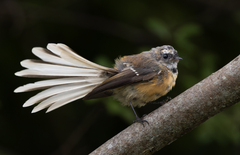

The animals people record most often in Abel Tasman National Park include the Long-nosed Fur Seal, the Common Brushtail Possum, the Weka, the South Island Robin, the New Zealand Fantail, the Chorus Cicada and the Wellington Tree Wētā. The most recorded plant is silver fern.
Most recorded here
The species with the most research-grade observations on iNaturalist, and how many each has. Most recorded doesn't mean native.
Birds
 Weka Gallirallus australis376
 South Island Robin Petroica australis86
 New Zealand Fantail Rhipidura fuliginosa75
 Variable Oystercatcher Haematopus unicolor60
- New Zealand Pigeon Hemiphaga novaeseelandiae59
 New Zealand Bellbird Anthornis melanura58
- Australasian Swamphen Porphyrio melanotus55
 Kelp Gull Larus dominicanus44
 Pied Cormorant Phalacrocorax varius30
 Silver Gull Chroicocephalus novaehollandiae30
Plants
 Silver fern Cyathea dealbata112
- Climbing clubmoss Lycopodium volubile100
 Climbing rātā Metrosideros perforata93
 Scarlet rātā vine Metrosideros fulgens68
 Black tree fern Cyathea medullaris62
 Rimu Dacrydium cupressinum60
 Kidney fern Hymenophyllum nephrophyllum58
 Shining Spleenwort Asplenium oblongifolium52
- Himalayan honeysuckle Leycesteria formosa50
- Willow-leaved hakea Hakea salicifolia50
Insects
 Chorus Cicada Amphipsalta zelandica26
- Wellington Tree Wētā Hemideina crassidens26
- Tanguru chafer Stethaspis suturalis22
 Buff-tailed Bumble Bee Bombus terrestris20
 New Zealand Common Tiger Beetle Neocicindela tuberculata17
 Common European Yellowjacket Vespula vulgaris13
 Migratory Locust Locusta migratoria11
 Prickly Stick Insect Acanthoxyla prasina11
 Steelblue Lady Beetle Halmus chalybeus9
 9
Spiders and kin
 New Zealand Nursery Web Spider Dolomedes minor11
- 5
 Flattened Bark Spider Hemicloea rogenhoferi4
 Knobbled Orbweaver Socca pustulosa4
- Long-bodied Cellar Spider Pholcus phalangioides3
Mollusks
 Little Black Mussel Xenostrobus neozelanicus7
- Snakeskin Chiton Sypharochiton pelliserpentis6
- Radiate Limpet Cellana radians6
 Horse Mussel Atrina zelandica6
 Cook's Turban Cookia sulcata6
 New Zealand Green-lipped Mussel Perna canaliculus5
- Mudflat Tītiko Amphibola crenata4
 Arabic Volute Alcithoe arabica4
- Spotted Top Snail Diloma aethiops4
 Pipi Paphies australis4
How a trip works
A trip has its own trail of lessons: meet six species, match them to new photos, then practice with four choices. Species you learn go into your Fieldbook, and starting a trip earns its Passport stamp. Your home place stays as it is.
Your first lesson starts right away, with real photos. Free, no sign-up.
Species lists and counts from research-grade observations on iNaturalist, as of November 2026. Parks outside the U.S. are from the World Database on Protected Areas (UNEP-WCMC and IUCN, Protected Planet). KnowKi is not affiliated with the National Park Service or any park's managers. Free, with no ads, no account, and no purchases.
Photo credits
Weka: (c) Indra Bone, CC BY-NC; South Island Robin: (c) Samuel Amaris, CC BY-NC; New Zealand Fantail: (c) Caiden, CC BY-NC; Variable Oystercatcher: (c) Finn Davey, CC BY-NC; New Zealand Bellbird: (c) Sam Moynan, CC BY-NC; Kelp Gull: (c) Finn Davey, CC BY-NC; Pied Cormorant: (c) Caiden, CC BY-NC; Silver Gull: (c) marlenekraml, CC BY-NC; Silver fern: (c) David Hutchinson, CC BY-NC; Climbing rātā: (c) Zac Sanson, CC BY; Scarlet rātā vine: (c) Simon Nicholas, CC BY-NC; Black tree fern: (c) Katja Schulz, CC BY; Rimu: (c) iandeas, CC BY-NC; Kidney fern: (c) Alison Pollack, CC BY-NC; Shining Spleenwort: (c) Barbara Parris, CC BY-NC; Chorus Cicada: (c) Karl Kroeker, CC BY-NC; Buff-tailed Bumble Bee: (c) Thijs Valkenburg, CC BY-NC; New Zealand Common Tiger Beetle: (c) Jon Sullivan, CC BY; Common European Yellowjacket: (c) Jakob Fahr, CC BY-NC; Migratory Locust: (c) Enrique Baquero, CC BY-NC; Prickly Stick Insect: (c) Museum of New Zealand Te Papa Tongarewa , CC BY; Steelblue Lady Beetle: (c) James Niland, CC BY; Mecodema venator: (c) memopob, CC BY-NC; New Zealand Nursery Web Spider: (c) miyang, CC BY-NC; Flattened Bark Spider: (c) Steve Kerr, CC BY; Knobbled Orbweaver: (c) Saryu Mae 前 朝琉, CC BY; Little Black Mussel: (c) temmitt, CC BY-NC; Horse Mussel: (c) Mike Lusk, CC BY-NC; Cook's Turban: (c) Saryu Mae 前 朝琉, CC BY; New Zealand Green-lipped Mussel: (c) Saryu Mae 前 朝琉, CC BY; Arabic Volute: (c) Saryu Mae 前 朝琉, CC BY; Pipi: (c) Lloyd Esler, CC BY-NC. Photos from iNaturalist, used under their Creative Commons licenses.