Learn the wildlife of national parks
Learn the wildlife of Waraira Repano National Park
Venezuela
605 species have research-grade observations inside Waraira Repano National Park on iNaturalist. KnowKi turns the most recorded into short lessons with real photos, so you know what you're looking at before you go.
Meet the birds of Waraira Repano National Park →Your first lesson starts right away, with real photos. Free, no sign-up.
What animals live in Waraira Repano National Park?
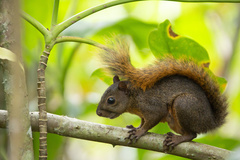
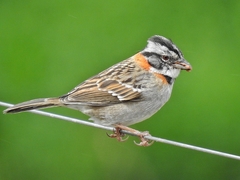
The animals people record most often in Waraira Repano National Park include the Red-tailed Squirrel, the Brown-throated Three-toed Sloth, the Ursine Howler Monkey, the Green Jay, the Rufous-collared Sparrow, the Collared Trogon, the Caliper beetle and the Red Flasher. The most recorded plant is tropical brackenfern.
Most recorded here
The species with the most research-grade observations on iNaturalist, and how many each has. Most recorded doesn't mean native.
Birds
- Green Jay Cyanocorax yncas54
 Rufous-collared Sparrow Zonotrichia capensis30
- Collared Trogon Trogon collaris21
 Venezuelan Parakeet Pyrrhura emma17
- Blue-capped Tanager Sporathraupis cyanocephala16
- Groove-billed Toucanet Aulacorhynchus sulcatus15
 Violet-headed Hummingbird Klais guimeti13
- Brown-capped Vireo Vireo leucophrys12
 Speckled Tanager Ixothraupis guttata12
 Spangled Coquette Lophornis stictolophus11
Plants
- Tropical brackenfern Pteridium arachnoideum7
 White leadtree Leucaena leucocephala4
- 4
 4
 Busy Lizzie Impatiens walleriana3
 Common bamboo Bambusa vulgaris3
- Black-eyed Susan vine Thunbergia alata3
- Parrot's Beak Heliconia psittacorum3
 Trumpet tree Cecropia peltata3
 3
Mammals
 Red-tailed Squirrel Sciurus granatensis7
- Brown-throated Three-toed Sloth Bradypus variegatus6
- Ursine Howler Monkey Alouatta arctoidea2
 Southern Long-nosed Armadillo Dasypus novemcinctus1
Insects
- Caliper beetle Golofa porteri17
- Red Flasher Panacea prola14
 Bandaged Satyr Oressinoma typhla13
 Clysonymus Longwing Heliconius clysonymus13
- Zebra Longwing Heliconius charithonia12
- Monarch Danaus plexippus9
 Common Morpho Morpho helenor9
- 9
 9
- Gray Cracker Hamadryas februa8
Spiders and kin
- Silver Garden Orbweaver Argiope argentata4
- Pinktoe Tarantula Avicularia avicularia3
 Golden Silk Spider Trichonephila clavipes3
- Green Lynx Spider Peucetia viridans2
 2
 2
- 2
- Trinidad Dwarf Tiger Tarantula Cyriocosmus elegans2
 2
 Brown Widow Latrodectus geometricus1
Reptiles
- Venezuela Lancehead Bothrops venezuelensis9
- Audubon's Multicolored Lizard Polychrus auduboni6
- Trinidad Ameiva Ameiva atrigularis5
 Venezuelan Mountain Skink Orosaura nebulosylvestris5
 Neotropical Rattlesnake Crotalus durissus3
 Boa Constrictor Boa constrictor3
 Rainbow Forest-Racer Dendrophidion nuchale3
- Leaf Anole Anolis planiceps3
- Mountain Sipo Chironius monticola2
- 2
How a trip works
A trip has its own trail of lessons: meet six species, match them to new photos, then practice with four choices. Species you learn go into your Fieldbook, and starting a trip earns its Passport stamp. Your home place stays as it is.
Your first lesson starts right away, with real photos. Free, no sign-up.
Species lists and counts from research-grade observations on iNaturalist, as of November 2026. Parks outside the U.S. are from the World Database on Protected Areas (UNEP-WCMC and IUCN, Protected Planet). KnowKi is not affiliated with the National Park Service or any park's managers. Free, with no ads, no account, and no purchases.
Photo credits
Rufous-collared Sparrow: (c) Esteban Poveda, CC BY; Venezuelan Parakeet: (c) Oswaldo Hernández, CC BY-NC; Violet-headed Hummingbird: (c) Oswaldo Hernández, CC BY-NC; Speckled Tanager: (c) Manuel Raab, CC BY-NC; Spangled Coquette: (c) Don Marsille, CC BY-NC; White leadtree: iNaturalist contributor, CC0; Espeletia neriifolia: (c) Steven Bodzin, CC BY; Busy Lizzie: (c) Vinicius P. dos S. F., CC BY-NC; Common bamboo: (c) darilismelendez84, CC BY-NC; Trumpet tree: (c) ceph0761, CC BY-NC; Bejaria ledifolia: (c) nurietta, CC BY-NC; Red-tailed Squirrel: (c) Joshua Wade Covill, CC BY-NC; Southern Long-nosed Armadillo: (c) javierluque89, CC BY-NC; Bandaged Satyr: (c) Jackie Riley, CC BY-NC; Clysonymus Longwing: (c) Roger Rittmaster, CC BY; Common Morpho: (c) Luis Trinchan, CC BY-NC; Polistes myersi: (c) Karen Yukich, CC BY-NC; Golden Silk Spider: (c) Francisco Herrera, CC BY-NC; Eriophora edax: (c) juliamarkey, CC BY-NC; Micrathena sexspinosa: (c) Karl Kroeker, CC BY-NC; Linothele curvitarsis: (c) Jesús Briceño, CC BY-NC; Brown Widow: (c) Wayne Fidler, CC BY-NC; Venezuelan Mountain Skink: (c) Jhonathan Miranda, CC BY-NC; Neotropical Rattlesnake: (c) Lucas Botelho, CC BY-NC; Boa Constrictor: (c) nicolas burnel, CC BY-NC; Rainbow Forest-Racer: (c) Santiago Ron, CC BY-NC. Photos from iNaturalist, used under their Creative Commons licenses.